There’s a Better Way to Fix Your Bunion
Why minimally invasive bunion surgery is changing what patients should expect from recovery.
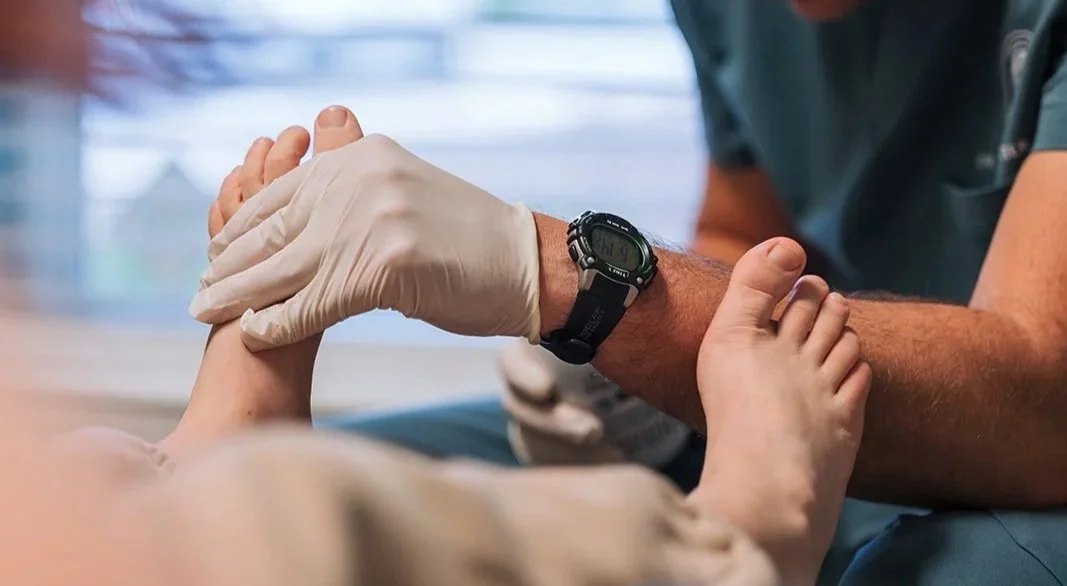
You’ve been putting it off. The bump on the side of your big toe has gotten bigger, your shoes don’t fit, and every step on hard floors is a reminder that something is wrong. You know you may need surgery — but the thought of a large incision, months off your feet, and a long painful recovery has kept you from making the call.
At Grants Pass Podiatry, we want you to know: bunion surgery has changed dramatically. Minimally invasive bunion surgery (MIBS) now offers patients the same powerful bone correction as traditional open procedures — through tiny keyhole incisions, with far less downtime, less pain, and faster return to life.
What Exactly Is a Bunion?
A bunion — medically called hallux valgus — is a progressive deformity where the big toe drifts toward the second toe, forcing the first metatarsal bone outward and creating a bony prominence on the inner edge of the foot. It’s not just a cosmetic issue. Untreated bunions cause chronic pain, difficulty walking, shoe-fitting problems, and over time, secondary deformities like hammertoes and calluses.
Bunions affect an estimated one-third of adults in the United States. They worsen over time and will not resolve on their own — only surgical correction can realign the bones.
Minimally Invasive vs. Open Surgery: Side by Side
Here’s what the difference looks like in practical terms:
| Category | Minimally Invasive (MIS) | Traditional Open Surgery |
|---|---|---|
| Incision size | 3–5 mm (keyhole) | 4–6 cm (large) |
| Hospital stay | Outpatient / same-day | Often overnight |
| Weight-bearing | Immediate in surgical boot | Non-weight-bearing 4–6 weeks |
| Return to normal shoes | ~6–8 weeks | 3–4+ months |
| Post-op pain | Lower — less tissue trauma | Higher — extensive soft tissue disruption |
| Scarring | Minimal — tiny entry points | More visible scar |
| Wound complications | Lower risk | Higher risk |
“MIBS demonstrated faster postoperative recovery, reduced pain, shorter hospital stays, and higher patient satisfaction — with sustained gains in function and pain relief over time.”
How Minimally Invasive Bunionectomy Works
The gold-standard minimally invasive approach is the Minimally Invasive Chevron and Akin (MICA) osteotomy. Through two or three small incisions — each less than half an inch — a specialized burr is used to precisely cut and shift the first metatarsal bone into correct alignment. The realigned bone is secured with small titanium screws, and a secondary cut is made at the base of the big toe to fine-tune rotation and angle.
The entire procedure is guided in real time using fluoroscopic X-ray imaging, giving the surgeon continuous visual confirmation of bone position. Because there is no large incision, the surrounding tendons, nerves, and blood vessels are left undisturbed — and that is precisely why recovery is so much faster.
Patients walk out of the procedure the same day in a surgical boot and can bear weight immediately. Most transition to athletic shoes within six to eight weeks.
What the Research Shows
The evidence in favor of minimally invasive bunionectomy has grown substantially in recent years:
JOURNAL OF CLINICAL MEDICINE, 2025 — MULTI-DIMENSIONAL SYSTEMATIC REVIEW (22 STUDIES)
A comprehensive review of 22 studies with a minimum two-year follow-up found that MIBS delivered faster recovery, higher patient satisfaction, improved quality of life, and fewer wound complications compared to open surgery. Radiographic correction was durable, and MIBS was more cost-effective over time due to shorter operating times and accelerated recovery. The authors concluded that MIBS offers substantial advantages for most patients undergoing bunion correction.
PUBMED — MICA OUTCOMES STUDY, 2023
A consecutive series of 94 patients undergoing MICA procedures found that 94% reported good or excellent satisfaction. Hallux valgus angle improved from 26.8° to 10.3°, and intermetatarsal angle improved from 12.6° to 5.7° — clinically significant bone realignment confirmed on X-ray. Immediate post-operative weight-bearing was permitted for all patients, and all osteotomies achieved complete bone union.
PMC — COMPARISON IN OLDER PATIENTS, 2024
A 2024 study compared MIS and open bunionectomy in patients over 65 — a group traditionally considered higher-risk for surgery. MIS patients demonstrated significant improvement in physical function at one year post-operatively, while open surgery patients did not reach that same milestone until the two-year mark. Both groups achieved equivalent radiographic correction, but MIS offered a notably faster functional recovery trajectory.
EUROPEAN JOURNAL OF ORTHOPAEDIC SURGERY & TRAUMATOLOGY, 2024 — MICA 2-YEAR FOLLOW-UP
A case series of 69 feet with a minimum two-year follow-up found that MICA osteotomy produced dramatic improvements: AOFAS scores rose from 57.0 to 93.9 (out of 100), and pain scores dropped from 6.0 to 0.6 on a ten-point scale. 95.6% of patients rated their outcome as excellent or good.
SCIENCEDIRECT — 4TH-GENERATION MIS COMPLICATION REVIEW, 2025
A 2025 review of 72 fourth-generation MIS bunionectomy procedures found that 88.9% were completed without any notable post-operative complications, demonstrating that even during the early adoption phase of the newest technique generation, outcomes are safe and comparable to established open bunion surgery approaches.
PMC — MICA LONG-TERM OUTCOMES, 6.5-YEAR FOLLOW-UP (2024 IFFAS AWARD WINNER)
The largest published study of long-term MICA outcomes — 147 osteotomies in 101 patients with a mean 6.5-year follow-up — demonstrated sustained, significant improvement across all patient-reported domains: pain scores, walking and standing ability, and social interaction. Quality-of-life scores improved markedly from pre-operative levels and were maintained at final follow-up, confirming MICA as an effective, long-lasting solution.
Are You a Candidate for Minimally Invasive Bunionectomy?
MIBS is an excellent option for patients with mild to moderate bunion deformity who have not found lasting relief from conservative measures such as wider shoes, custom orthotics, or anti-inflammatory medications. It is also well-suited for active individuals who cannot tolerate months of non-weight-bearing recovery, and for older patients who benefit from faster functional return.
Severe deformities with complex bone and joint involvement may still require traditional open techniques — and our surgeons will be honest with you about which approach best suits your anatomy. What we offer is a thorough evaluation, a clear explanation of your options, and the surgical skill to deliver excellent results either way.
At Grants Pass Podiatry, you can expect:
A detailed pre-operative evaluation including weight-bearing X-rays
An honest conversation about whether MIS or open surgery is right for your deformity
Same-day outpatient surgery with immediate weight-bearing in a surgical boot
Minimal scarring — entry points measured in millimeters, not centimeters
A structured recovery protocol designed to get you back to life as quickly as possible
Long-term follow-up to ensure your correction holds
Ready to Stop Living Around Your Bunion?
Schedule a consultation at Grants Pass Podiatry. We’ll evaluate your bunion, walk you through your surgical options, and help you decide if minimally invasive bunionectomy is right for you.
Call Us Today (541) 476 - 4458
Grants Pass Podiatry · Serving Southern OregonSCIENTIFIC REFERENCES
Lonati D, Kannegieter E, McHugh D. A Multi-Dimensional Systematic Review of Minimally Invasive Bunion Surgery (MIBS). J Clin Med. 2025 Apr 17;14(8):2757. doi:10.3390/jcm14082757
Outcomes and Surgical Strategies of Minimally Invasive Chevron/Akin Procedures. PubMed, 2023. [MICA consecutive series, 94 patients, 94% satisfaction]
Comparison of Minimally Invasive and Open Bunion Surgery in Older Patients. PMC. 2024 Oct. doi:10.1177/24730114241263095
Ferraz Ferreira G, et al. Minimally Invasive Chevron-Akin (MICA) Osteotomies Without Akin Fixation in Hallux Valgus Correction: 2-year Follow-up. Eur J Orthop Surg Traumatol. 2024 Jul;34(5):2339–2345.
Complication Rates During Early Adoption of Fourth-Generation Minimally Invasive Bunion Surgery. ScienceDirect / J Foot Ankle Surg. 2025. doi:10.1016/j.jfas.2025
2024 IFFAS Award Winner: Minimally Invasive Chevron Akin for Hallux Valgus Surgery — Prospective Observational Study with Mean 6.7-Year Follow-Up. PMC. 2024 Dec.
Grants Pass Podiatry · Grants Pass, Oregon · This content is for educational purposes and does not constitute medical advice. Consult your podiatrist to determine which bunion correction approach is appropriate for your condition.